
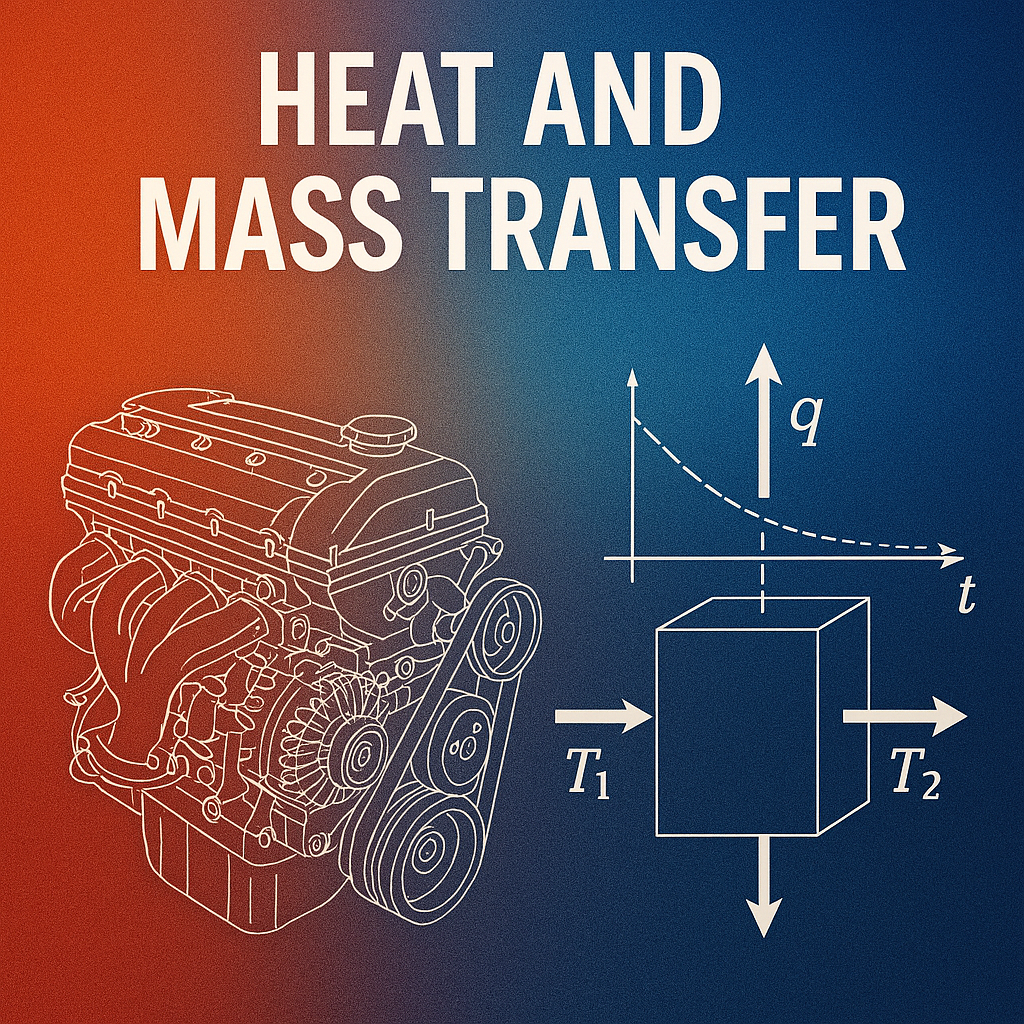
Course Overview
Heat and Mass Transfer is a foundational engineering course that equips learners with the knowledge and skills required to analyse thermal and mass transport processes occurring in automobile systems. The course emphasises practical understanding, engineering calculations, and real-world applications, including engine cooling, exhaust heat recovery, air-conditioning systems, lubrication, and thermal insulation.
By the end of the course, learners are able to identify, analyse, and solve heat and mass transfer problems relevant to modern automotive technology, while applying safety, efficiency, and sustainability principles in line with industry standards.
LEARNING UNIT 1 – DESCRIBE BASICS OF HEAT TRANSFER
Unit Description
This learning unit introduces the fundamental concepts of heat transfer and forms the theoretical backbone for understanding thermal processes in automobile systems.
Key Learning Content
v Definition of heat and thermal energy
v Difference between heat and temperature
v Thermodynamic systems and surroundings
v Modes of energy transfer
v Temperature scales (Celsius, Kelvin, Fahrenheit)
v Thermal equilibrium and Zeroth Law of Thermodynamics
v Physical properties affecting heat transfer:
Ø Thermal conductivity
Ø Specific heat capacity
Ø Density and thermal diffusivity
Learning Outcomes
By the end of this unit, learners should be able to:
v Explain basic heat transfer concepts using correct engineering terminology
v Distinguish between heat and temperature in automotive contexts
v Identify thermal properties of materials used in automobile components
v Apply basic heat concepts to engines, brakes, and exhaust systems
Automotive Applications
v Heat generation in internal combustion engines
v Heat storage in engine blocks and cylinder heads
v Selection of materials for pistons, valves, and brake systems
LEARNING UNIT 2 – DESCRIBE HEAT TRANSFER MODES
Unit Description
This unit focuses on the three fundamental modes of heat transfer and how they occur individually or simultaneously in automobile systems.
Key Learning Content
- Conduction
- Fourier’s Law of heat conduction
- Steady and unsteady heat conduction
- Thermal resistance concept
- Convection
- Natural and forced convection
- Newton’s Law of Cooling
- Heat transfer coefficient
- Radiation
- Thermal radiation principles
- Stefan–Boltzmann Law
- Emissivity and absorptivity
- Combined heat transfer mechanisms
Learning Outcomes
Learners will be able to:
v Describe and differentiate conduction, convection, and radiation
v Perform basic heat transfer calculations
v Analyse heat flow paths in automotive systems
v Explain the interaction of multiple heat transfer modes
Automotive Applications
- Conduction through engine walls and exhaust manifolds
- Forced convection in radiator cooling systems
- Natural convection around engine components
- Radiation heat losses from exhaust systems and turbochargers
LEARNING UNIT 3 – DESCRIBE PRINCIPLES OF HEAT EXCHANGERS
Unit Description
This unit introduces learners to heat exchangers, their working principles, classification, and performance analysis, with a strong emphasis on automobile applications.
Key Learning Content
v Definition and purpose of heat exchangers
v Classification of heat exchangers:
Ø Parallel flow
Ø Counter flow
Ø Cross flow
v Heat exchanger components
v Effectiveness and efficiency of heat exchangers
v Log Mean Temperature Difference (LMTD) concept
v Fouling and maintenance considerations
Learning Outcomes
At the end of this unit, learners should be able to:
v Explain how heat exchangers operate
v Identify different types of heat exchangers used in vehicles
v Analyse basic heat exchanger performance
v Carry out simple heat exchanger design calculations
Automotive Applications
v Radiators in engine cooling systems
v Oil coolers and intercoolers
v Air-conditioning condensers and evaporators
v Exhaust gas heat recovery systems
Overall Competencies Gained
Upon successful completion of the course, learners will be competent to:
v Apply heat transfer principles to diagnose automotive thermal problems
v Support maintenance and design decisions related to cooling and HVAC systems
v Improve energy efficiency and thermal management in vehicles
v Prepare for advanced studies in automotive thermal systems and energy engineering
- Enseignant: James GAFURAMA