
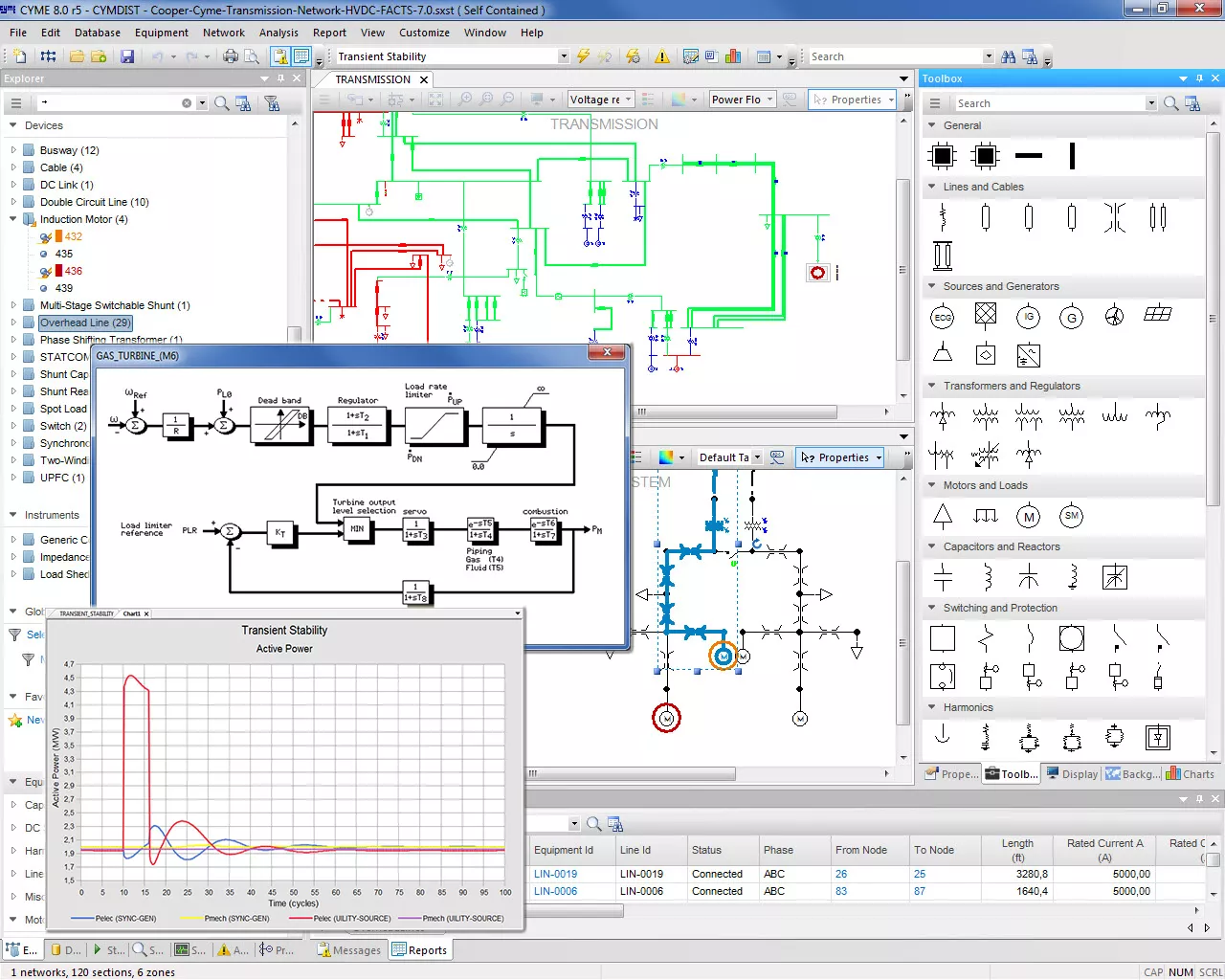
Power System Stability Analysis is an advanced electrical power engineering course that focuses on the ability of an electric power system to maintain a state of operating equilibrium under normal operating conditions and to regain an acceptable state of equilibrium after being subjected to disturbances such as faults, sudden load changes, loss of generation, or switching operations. The course equips students with the theoretical knowledge and practical analytical techniques required to assess, model, and improve the stability and reliability of modern power systems.
Students will study the different forms of power system stability, including rotor angle stability, voltage stability, and frequency stability. The course also covers mathematical modeling of synchronous generators, excitation systems, governors, and power system components, as well as methods for stability analysis using both analytical and simulation tools such as MATLAB/Simulink, ETAP, PSCAD, PowerWorld Simulator, or DIgSILENT PowerFactory.
Emphasis is placed on understanding transient and small-signal stability phenomena, stability enhancement techniques, renewable energy integration challenges, and modern grid control technologies. Practical case studies and computer-based simulations are used to reinforce theoretical concepts and develop problem-solving skills applicable to real-world power systems.
- Enseignant: NIYIREMA Jonas